


Sowing and growing peas in the garden: when, where and how?
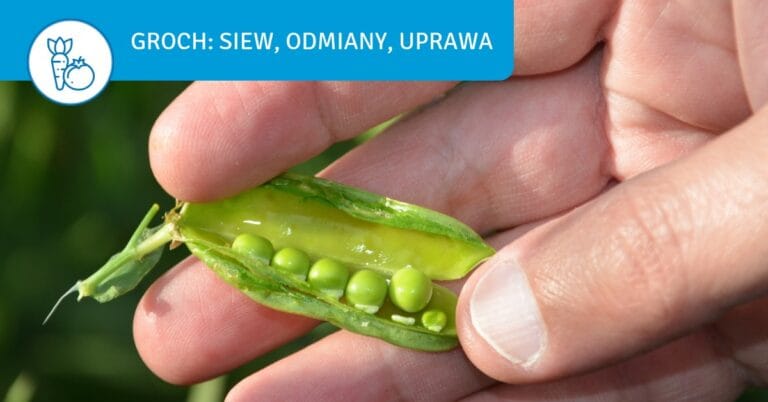
Peas are a green legume that is one of the richest sources of plant protein, as well as calcium, iron, magnesium or vitamins (PP, B1, B2, E). How to sow peas? What are its requirements? How do you grow peas in the garden or in pots?Peas are an annual plant, the sowing and cultivation of which are not difficult. There are many varieties of this plant, the oldest known one is the pea(Latin: Pisum sativum), in Poland there are also popular others, which are more delicate and sweeter: shell peas and sugar snap peas.
Examples of shell pea varieties:
➡ Six-week-old – early variety, resistant to diseases,
➡ Nephrite – early variety, sweet, good for canning,
➡ Pegasus – early variety, sweet, with large seeds.
Popular sweet pea varieties:
➡ Fairyland – a late variety, sweet, with large pods,
➡ Desiree – a distinctive variety with purple pods,
➡ Kent – an early variety with large grains.

Growing peas in the garden – what you should know
✅ Before sowing, first take care to prepare supports so that the plant can climb over them. You can make them yourself using longer sticks or old boards cut lengthwise. Peas also grow well next to pergolas, mesh fences, and against a wall (if they are supported).✅ Depending on the variety (dwarf / tall), peas reach a height of 70 to 200 cm.✅ Peas give better yields and are easier to grow if you sow them early.✅ Pea pods are ripe about 50-80 days after sowing.✅ The seedlings tolerate minor frosts well (down to about – 6°C), but if minus temperatures persist for more than a few days, the peas should be covered with material that keeps the heat in, such as agrofiber.✅ Once the seedlings are up, they should be systematically weeded and the soil loosened.
When to sow peas?
The best date for sowing peas is March and early April. It can also be sown at the end of April, with the exception that peas like a cold spring (pea seeds already germinate at 2°C), so sown at this date may yield less.
How to sow peas?
Seeds of peas are sown immediately into the ground, they can also be grown in pots. Peas should be sown singly, every 3-10 cm at a depth of about 4-5 cm. For dwarf varieties, the distance between rows should be about 15 cm, while tall varieties should be sown every 30 cm.

Where to sow peas?
Peas are best sown in the 2nd or 3rd year after fertilizing with manure. The optimal pH for peas is 6-7 pH, they can also be grown on soils with pH up to 7.5. As for substrate, peas do well on sandy soils with a small admixture of clay, so those that are permeable, moderately moist and rich in humus. The site for cultivation should also be well sunny.
However, the cultivation of peas does not succeed on acidic and very acidic soils, as well as those that are dry, sterile, or heavy, waterlogged. It is also not recommended to sow peas in the vicinity of garlic, onions or leeks, as this weakens their growth.
On the other hand, it is worth noting that peas are an excellent forecrop for vegetable species that have a high demand for nitrogen, because the papillary bacteria found on pea roots bind this element to the soil.
⚠ Note: peas a also other species of plants from the bean family (beans, broad beans, lupins) can be sown in the same place no more often than every 5 years.
Peas and peas are not the same thing
Finally, a little curiosity. Well, the names peas and peas are often used in the same sense as a term for edible varieties of legumes, but "pea" (Latin Lathyrus) is a different type of plant, from which comes, for example, peas or sweet peas.